
What We Fix
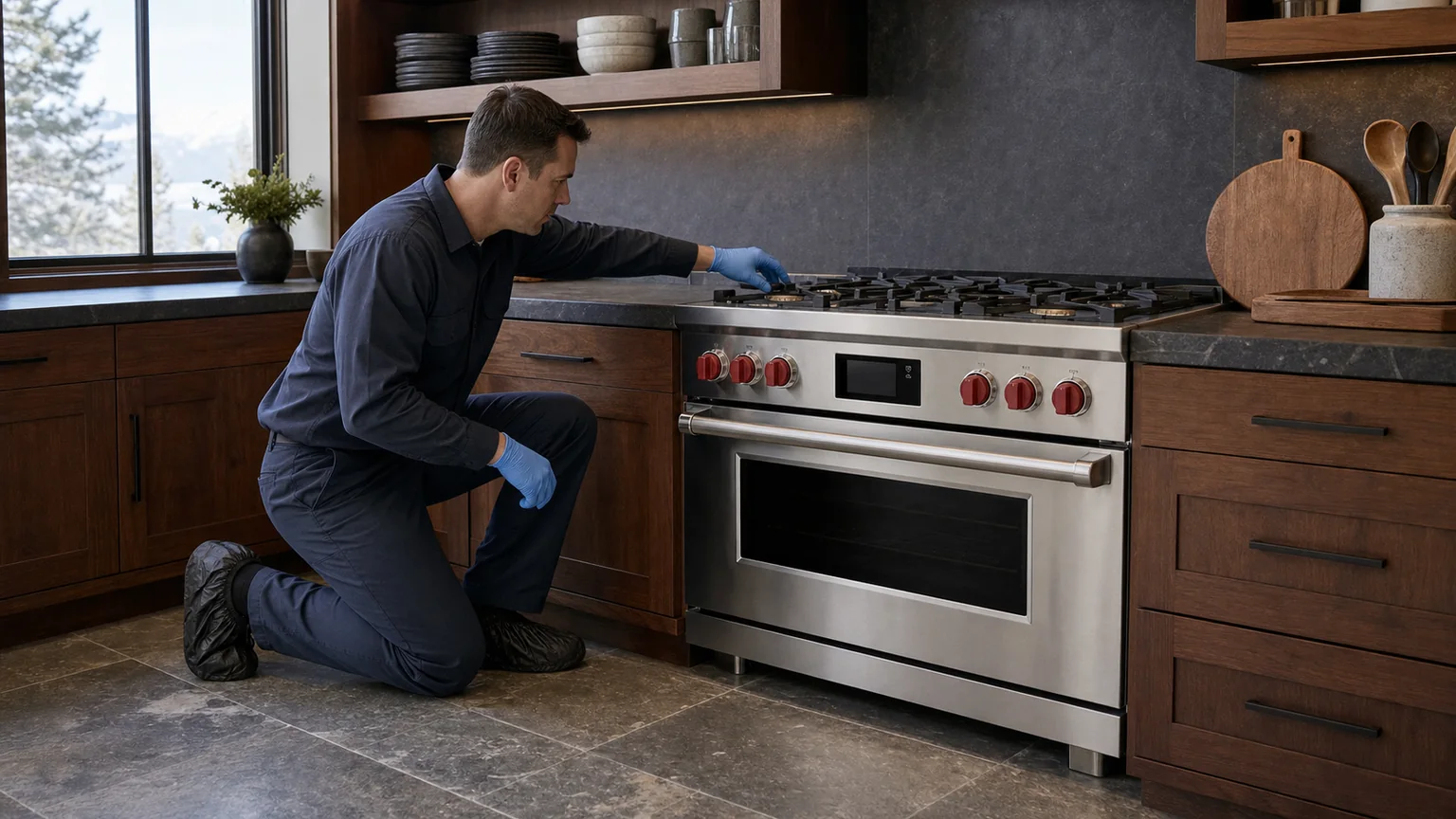
A pro range is the centerpiece of a serious kitchen, and Colorado Springs has plenty of them, from Wolf dual-fuel ranges in remodeled Hilltop homes to Viking and La Cornue ranges in the foothills. We repair the whole appliance: the sealed or open gas burners on top and the electric or gas oven below.
Common repairs include spark igniters and modules, burner heads and caps, gas valves and regulators, bake and broil elements, convection fan motors, oven temperature sensors, door hinges and gaskets, and control boards. Dual-fuel ranges get diagnosed as two systems, since the cooktop and oven fail in different ways.
Common Problems We See
- Burner will not light. Fouled cap, worn igniter, or a spark module that no longer fires reliably.
- Oven bakes unevenly. A failing convection fan, a drifting sensor, or altitude that needs recalibration.
- Oven will not reach temperature. A failed element, igniter, or control relay in the heat circuit.
- Simmer setting too high. A valve or air-fuel adjustment, more common at Colorado Springs elevation.
- Controls or display dead. A control-board or wiring fault, sometimes after a self-clean cycle.
Typical Causes
On the cooktop, spillover and grease foul igniters faster than most owners expect, and the spark module is the next suspect when a clean cap does not help. In the oven, elements, igniters, and convection motors are the usual wear parts. Altitude is a real factor here: a mile of elevation changes how gas burns and how baked goods rise, so recalibrating the oven and tuning the burners is often part of a proper repair rather than an afterthought.
A Range Is Two Appliances, and That Matters
The most useful thing to understand before booking a range repair is that a pro range is really two machines in one chassis. On a dual-fuel unit, the cooktop is gas and the oven is electric, and they share almost nothing beyond a frame and a badge. That is why a burner problem and a baking problem on the same range are two unrelated repairs, and why a technician who assumes one caused the other will waste your time.
On an all-gas range the two halves do share the gas supply, which means a supply or regulator issue can affect both at once. If your burners have gone weak and your oven has gone slow in the same week, that is worth mentioning when you book, because it points somewhere different than either symptom alone.
When you call, the details that shorten the visit are simple: dual-fuel or all-gas, which burner or which oven, and whether the problem shows from a cold start or only once the range is hot. That last one separates a marginal igniter from a component failing as it heats.
Gas Burners at 5,280 Feet
Colorado Springs air holds roughly 17 percent less oxygen than sea-level air, and a burner is fundamentally a device for mixing air and fuel in a set ratio. A range configured for a lower elevation runs fuel-rich here, and the signature is easy to read once you know it: a lazy flame with yellow tips instead of a crisp blue cone, soot collecting on the bottom of your pans, and a simmer that will not stay low.
Most ranges bought through Front Range dealers are set up for our altitude. The ones that are not usually arrived another way: brought from a lower-elevation home in a move, bought online from an out-of-state seller, or installed by a crew that skipped the altitude conversion. Tuning the air shutters and, where the model requires it, the orifices is straightforward work once someone identifies it as the cause.
We are equally direct about what altitude does not explain. It will not make a burner click without lighting, and it will not stop an oven reaching temperature. Those are igniter, spark module, or valve faults, and they deserve a repair rather than a shrug about the elevation.
Brands We Service
We repair ranges from Wolf, Viking, La Cornue, Thermador, Dacor, Miele, and Jenn-Air.
Range Fault Indicators
| Symptom | Likely Cause | Fix |
|---|---|---|
| Burner clicks, no flame | Igniter or spark module | Clean cap, replace igniter or module |
Oven E1 code (Wolf) | Temperature sensor or over-temp | Replace sensor, verify control |
| Oven slow to heat | Weak element or igniter | Replace heat component |
| Uneven bake | Convection fan or calibration | Replace fan, recalibrate for altitude |
Range Not Performing?
Book a visit and we will diagnose it and quote the repair in writing. Diagnostic and travel fees, if applicable, are confirmed before the appointment and before repair approval.
Schedule Service Call Today